
I owe my career to Newsweek magazine. Long before it launched a tablet format—or any online format for that matter—the iconic news magazine published on its “My Turn” page an essay I wrote when I was 16.

I was 16 when publishing an essay in Newsweek magazine landed me an appearance on “Good Morning America” with Dana King.
When that issue hit the stands in May 1993, my entire high school suddenly knew my name—and face, as the article included my picture. The essay centered on the fact that students at my ethnically mixed campus self-segregated themselves by race as they got older, and offered ideas of what schools could do to improve race relations. Teachers across the country assigned the essay to their classes and debated its merits. Two local TV stations interviewed me on campus. Next thing I knew, Good Morning America flew me to New York to discuss racial issues with then-Senator Julian Bond. I came home to find hundreds of letters sent from around the world. I was never popular in school, but for a week I came close. That was the same week I knew I wanted to earn a living as a writer.
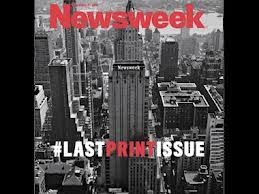 In releasing their final print issue this week (with the telling hashtag #LASTPRINTISSUE on its cover), Newsweek staffers have done their best to spin it as an evolution to an all-digital format rather than a result of declining circulation. Flipping through the issue at a magazine rack, I felt the same time-capsule sensation as when I bought a newspaper the day Obama was elected president. History. Nostalgia. Black and white photographs. The “My Turn” page—which in its heyday was written by freelancers and everyday folks rather than seasoned reporters—no longer existed.
There is much to be enthused about in all-digital news. Entering keywords to find relevant articles is quick and precise. Once issues are archived and searchable, decades-old stories can reach new audiences online. Dropping print saves a gazillion trees. Even the “curl up in bed” factor is diminishing thanks to increasingly cozy Kindles and Nooks. I also noticed the last print issue of Newsweek didn’t hit my neighborhood Walgreens in San Francisco until a full week after its December 24 release—eons ago in digital time.
Yet I wonder: In the absence of print, can my experience ever be replicated? Will a 16-year-old writing for a high school newspaper get the same thrill seeing a story scrolling on a mobile device versus the hand-feel of smudgy newsprint? Will 500 Facebook likes feel as gratifying as receiving a heartfelt letter in the mail? Will a teenager’s blog ever land him or her on national television?
I’m the last person who should be lamenting the decline of a print magazine, as I haven’t paid for a subscription in well over a decade. My hard copy of the Newsweek article I wrote, long ago scanned and PDF’d, now gathers dust in a box of diplomas and athletic trophies. As of this week, the very fact that it’s in print will say as much about it and the time it was written as the actual content of the article.
But like the book collection that I’ve lugged to each of the half-dozen cities in which I’ve lived, I can never entirely let go of print, even when the time comes that people view hard copies of anything as nothing more than a historical artifact or living room decoration.
On second thought, that time is already here.
 Brian Jarvis
You must be logged in to post a comment.