
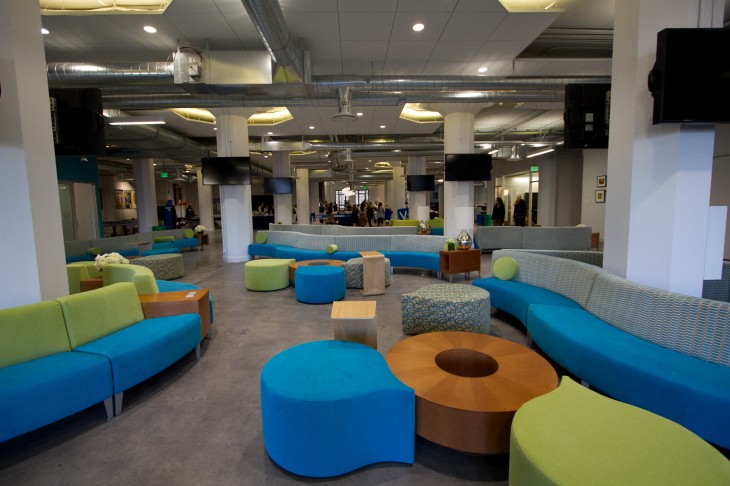
Yammer’s new digs in downtown San Francisco are the epitome of startup chic.
Visiting a colleague at the plush 80,000 square feet that enterprise social network provider Yammer now calls home, I felt pleasantly barraged by sensory stimuli. The foodie in me wanted to gobble down the complimentary baked salmon with cucumber dill sauce and garlic-encrusted green beans; the man-child wanted to beeline to the full-size Street Fighter II machine; the photographer wanted to shoot away at the industrial-themed backdrop, silhouetted by a windowed city skyline. And the consultant wanted to start handing out business cards—or, better yet, shut down my freelance operation and apply for a full-time position.
Yammer relocated to the Twitter office building on Market Street earlier this month, adding to the starring role of tech in downtown San Francisco. Thank the City for its revised tax code aimed to lure star tenants to run-down areas, not to mention its confluence of social and cultural offerings, from Burmese food trucks to Opera in the Park, that’s tough to match. To hip newcomers, San Jose just ain’t that hip.
Herein lies the 21st Century American dream—or rather, startup dream, rooted in companies that provide digital solutions (and therefore eco-friendly, no factories, few spare parts), backed by alluring office spaces with all the amenities of a college rec center. Yammer may have been acquired by the notoriously uncool Microsoft last summer, but there are no visible signs of Dilbert-esque corporate culture. Only brightly colored couches that wrap around like a Slinky, delicious free food and a stocked fridge of microbrews that can only prove IPAs mix with IPOs. Plus the requisite pool table, chillaxin’ pods hanging from the ceiling, and a dress code as stringent as a neighborhood high school. Naturally you can bring your dog to work. Best of all in this dream are the people, the rare breed with whom you can work, play and share a drink. To quote Yammer’s own job listings: “We hang out together and we make fun of each other. We have difficult conversations out in the open. We call ourselves out on our own bullshit.” Talk about an idealized ethos.
Big money is part of the startup fantasy too, and tech has produced no shortage of millionaires in recent years. But to the millennial generation known to prioritize culture over cash, tech enables them to prolong a youthful lifestyle as few respectable careers can. The typical salary, while not on par with Goldman Sachs, is lavish enough to purchase property in a market that is fast squeezing out teachers, police officers, and other remnants of the dwindling middle class.
The startup dream also offers a chance to create the next big thing, though some might argue that Yammer didn’t “create” the social network, any more than Google created the search engine. Instead Yammer found a fresh spin on an existing technology and repackaged it with such zing and zest that clients can scarcely imagine a day without it, much like Facebook for businesses. Enter the buzz phrase of our times: disruptive innovation. In the five years since its launch, Yammer has sold its services to more than 80,000 companies worldwide.
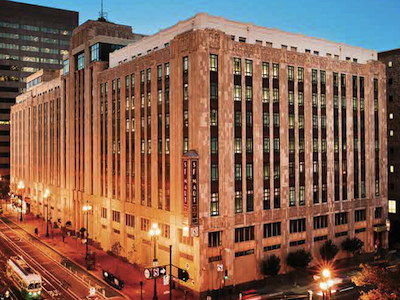
Yammer’s new office building sits in the heart of San Francisco’s growing tech hub.
There are caveats to the startup dream, beginning with the fact that, like restaurants and retail, most startups fail. Critics call out the booming tech industry for pushing out small businesses and affordable rents. To which I counter that’s the price for gentrifying any American city that saw half of its urban tax base migrate to suburbia. Tech jobs themselves tend to skew toward engineers and gearheads on one side of the room, with sales reps, marketing types and bean counters on the other. Such are the greatest needs of a startup: those who can build, and those who can sell. If you possess other skills but don’t know JavaScript from Java coffee, it will be tougher to find a role. And for those who think of tech as the hoodie’d domain of slackers and their foosball, insiders know that life at a typical startup—starting in beta mode—can be uncomfortably unpredictable, socially isolating, and require grueling hours; an “overnight success” is really years in the making. Meanwhile startups rely on VC-backed funds that can dry up in a nanosecond. For a scathing review on the challenges of startup life, ask Brazen Careerist founder Penelope Trunk.
Outside the bubble of the San Francisco Bay Area, most non-techies fail to see the romance in staring at a screen all day. But the same could be said of repairing beat-up roadsters in the Midwest. Passion lies in the pupils of the starry-eyed beholder. In the Oz of San Francisco, our passion comes in the form of scrappy startups, with their CEOs as our rock stars, and their products shaped by our drive to be the “first ever” and do some digital good in the universe.
To see the top 12 “coolest” startup offices in San Francisco, click here.
 Brian Jarvis
Yammer crib is surely cool, but the ‘dinasaur law’ (organizations tend to get real big right before they go extinct) comes to mind. Bitrix24 pushed out Yammer out of SMB market, despite being a beta and not even one year old. Probably the best social intranet Saas on the market right now. Jive seems to be fairly successful at gobbling up XXL enterprise clients. Podio is nearly as bad as Yammer. Wrike and Asana have better PM modules. Makes me worried about Yammer fate.