
- “Is PA ready to shoot?”
- “Affirmative. PA is standing by.”
- “Shoot away.”
PA stands for Public Affairs, where “shooting” a human target is done primarily with a video or still camera. It’s where military meets media, and it’s the only job I’ve had—or wanted—in the Air Force.
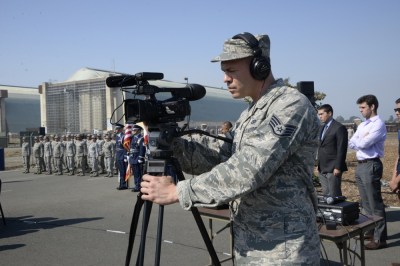 Before enlisting I spent the better part of a decade in journalism. Newspaper reporter, radio producer, TV anchor. My dream job was foreign correspondent, but due to budget cuts, most major news outlets had already begun downsizing their overseas bureaus if not gutting them altogether. How else could I combine my love of storytelling with a burning desire to travel? Enter Public Affairs.
But is military public affairs really journalism? And is it good training for those new to the field or those simply looking for a way to stay connected? Here’s what they have in common:
Find a good story. Military service has a rep for everyone “doing as they’re told,” but my PA supervisors in the Air Force rarely instruct me on what to report each day. Even in the Mideast desert while deployed, I find newsworthy subject matter the same way I did as a civilian reporter: pounding the pavement (or in this case pounding the sand), talking to people, attending meetings and councils, and handing out business cards. Unless I’m editing, there’s no reason to be sitting inside a stuffy office.
Multimedia, multiplatform, multitask. As traditional newsrooms crews have grown leaner and more versatile, so have military PA teams. Since taking broadcast journalism at the Defense Information School in 2013, the program has already restructured itself so that every student is trained in print writing, still photography, radio and video operations, plus additional courses in graphic design and social media. A generation ago each of those interests was a full-time job in itself. Today they’re all increasingly carried out by one enterprising backpacker. The PA shop at my deployed location, in fact, has only four personnel to cover a base occupied by thousands of service members.
Travel. Journalism can take you places, and so can the military. As a journalist, I had access to major events from NASCAR races and death penalty trials to presidential debates. As a military broadcast journalist, I’ve interviewed generals, flown on helicopters and documented training missions in Hawaii, the Azores and the United Arab Emirates. Note these “missions” included 12-hour workdays and cramped living quarters, such as tents. Journalism by definition will get you in the thick of the action.
“Tell the truth. Minimize harm.” This is the journalist’s creed I was taught. It’s up for debate how many news outlets still adhere to this principle in the era of the 24-hour news cycle, but the military always looks to mitigate risk when it comes to the release of information. Examples: I recently covered a refueling mission that ultimately dropped bombs on an Al Qaeda opium field in order to disrupt their production and revenue stream. Releasing the story too soon clearly would have jeopardized the mission. Or, when producing stories on everyday Air Force activities, I often blur out identifying numbers on planes or last names on uniforms in order to protect identities from those who seek to do harm to the U.S.
Final takeaway: Even if you have no desire to enlist in the military, as a civilian journalist you can still cover the military. News outlets like military.com and Stars & Stripes are largely run by civilians with no military background. Or to get a full-on taste, apply to be embedded within an overseas military unit and see it up close.
 Brian Jarvis
You must be logged in to post a comment.