Don’t Let Your Writing Get “Ghosted” on the Web

Ghosting refers to more than a hot date who suddenly pulls a disappearing act on you. Your work as a writer can disappear too.

Sometime in the ‘00s, saving copies of your writing in any shape or form became a thing of the past. After all, once you publish online—be it a freelance article for a news site or a blog post for a company landing page—digital ink is permanent, right?

Wrong.
ghost-emojiOver my 15-year writing career, it’s likely that 95 percent of the articles I wrote have vanished from the Internet. Gone. Poof. Google turns up zilch.

Whether you’re a blogger, journalist or content creator, chances are you’ve been “Internet ghosted” at least a time or two. It’s not so much the dark web we have to fear as it is the disappearing web. Take me for instance:

  • From 2006-2008 I was a daily reporter for two newspapers, but zero articles remain online. One paper deleted all its old articles after changing ownership; the other makes its archives inaccessible to non-paying subscribers.
  • While in graduate school at the Missouri School of Journalism, I wrote for its school-affiliated paper with a circulation of 100,000. Some of my articles remain but are blocked by a paywall put up without warning, thereby making the links unusable as writing samples to prospective clients.
  • In San Francisco I covered a tech conference and co-wrote a long-form blog post for its then-sponsor, wearableworld.com. Within six months the website rebranded as ReadWrite and removed any trace of wearable technologies. My contact there told me they had a “plan” to migrate older pieces but no timeline. Three years later and still nothing.
  • Over the last decade, I’ve written articles and guest posts for numerous startup sites, ranging from travel tips to small business marketing strategies. Nearly all of those sites are now shut down, and my copy vanished along with them.

I have more examples but you get the point. Clearly this is a trend.

So next time your writing is published, don’t leave fate in the hands of a webmaster. Reprint articles on your personal blog and be sure to list or link to the original source. Print them out the old-fashioned way and store for your records. Or, if you don’t want to kill trees, save them as PDFs and email the PDFs to yourself. While you’re at it, if you still write rough drafts in Word as opposed to a cloud-based app, get in the habit of emailing drafts to yourself at the end of the day.

If not, a day may come when you suddenly need to dig up your work—to add to your LinkedIn profile, attach to a job application, or simply show off to a loved one—only to find that its been erased from (virtual) existence.

You can’t control what happens after you swipe right on Bumble, but you can control what happens to your writing. Don’t leave it to a ghost of a chance.

A version of this article also appears on LinkedIn.
Five Car Apps That Can Save You Bucks

With $3-plus gas prices as the new normal, traffic showing no signs of slowing while parking shortages are on the rise, driving can be as expensive and stressful as ever. Fortunately a number of handy car apps can save you time, money and maintenance. And they’re all free. Here are the top five: 

UnknownGasBuddy: True to its name, GasBuddy searches out the cheapest gas stations in your vicinity based on your location or by plugging in city/zip/postal code. This app relies on its user community to chime in on discrepancies and station details, all in the spirit of banding together to combat high gas prices. As with airline miles and credit cards, you can earn points and awards by participating (read: win free gas). The app cannot always distinguish between cash and credit prices, however, as many gas stations charge additional fees if you use a credit card. 

MetroMile: MetroMile monitors your driving stats in order to make better road decisions. You can figure out the best times for the fastest commutes and plan gas-efficient routes, check engine status, and receive reminders of where you parked. For this app to work, however, you’ll have to order a Metronome, a gizmo that plugs into your car’s diagnostic port under the dashboard (available in California, Oregon, and Washington to drivers of post-1996 vehicles, free of charge). Some reviews claim the stats are unreliable, so this app may be a work in progress. On its site, MetroMile sells insurance based on the number of miles driven, aimed at drivers who log in less than 10,000 miles a year. The app is available only on iPhone, iPad and iPod touch.

Continue reading

New Media Expo 2013: Four Quotes to Remember

Aside

NMXNow in its seventh year, the annual New Media Expo (formerly Blogworld  & New Media Expo) convened in Las Vegas last week for another of round of socializing on social media, where clever takeaways and pithy bullet points were posted, tweeted, liked and Google+’d at rapid-fire. For those not in attendance, here are four quotes to remember, lightly paraphrased:

Continue reading

Publications Going Digital Equals Progress, Not Regress

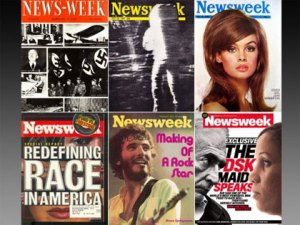
Newsweek’s iconic covers will become a relic of the past as the magazine switches to a digital-only format in 2013.

The last time I read a print newspaper, it was not a pleasant experience. Sitting in a cramped diner booth, I had to keep folding it like a paper airplane to fit around my food, nearly knocking over my water glass. The newsprint blackened my fingers, which then blackened my shirt. Flipping back and forth between pages quickly became work. I spent years reporting for newspapers, and still the temptation to whip out my iPhone was overwhelming. Finally I gave in and used my mobile device to pull up the same story I was reading, which now had several updates plus more info in the reader comments below. The coffee-stained paper, on the other hand, was both figuratively and literally old news.

Continue reading

#AskObama: History-making or ho-hum?

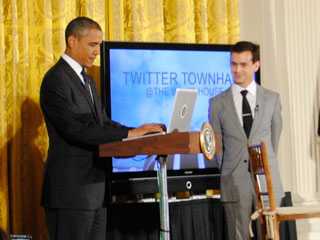
President Obama types his first tweet on Wednesday, July 6 as Twitter co-founder Jack Dorsey looks on.                        Photo: Dana Ritter/CBS News

President Obama, whom admirers tout as our first social media president — much like Bill Clinton was once touted as our first rock n’ roll president — decided this week that a Town Hall meeting could be micro-blogged.

Put another way, Obama read pithy questions off a screen in front of a press gaggle rather than take lengthy questions from a press gaggle. At least that’s how it looked via livestream.

Continue reading